

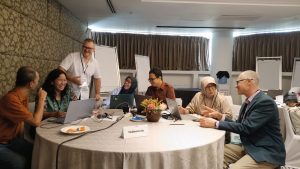
In response to the growing global threat to banana production, three lecturers from the Faculty of Agriculture, Universitas Gadjah Mada (UGM), actively participated in a co-design workshop held in Manila in March 2026. The delegation included Prof. Dr. Ir. Siti Subandiyah, M.Agr.Sc. from the Department of Plant Protection, along with Mrs. Valentina Dwi Suci Handayani, S.P., M.Sc., Ph.D. from the department of agronomy and Mrs. Alia Bihrajihant Raya, S.P., M.P., Ph.D. from the Department of Agricultural Socio-Economics. They are part of a collaborative research team under ACIAR, focusing on the management of banana wilt disease caused by Fusarium oxysporum f. sp. cubense Tropical Race 4 (TR4).
Fusarium oxysporum f. sp. cubense TR4 is widely recognized as one of the most destructive pathogens affecting global banana production, particularly the Cavendish variety, which dominates international markets. This soil-borne fungus invades the plant’s vascular system, leading to irreversible wilting and eventual plant death. Its persistence in soil for extended periods, even in the absence of host plants, makes it extremely difficult to control. The pathogen has spread from Southeast Asia to regions including the Middle East, Africa, and Latin America, posing a significant challenge to global food security. Beyond agricultural losses, TR4 outbreaks also result in substantial economic impacts on farmers and threaten the sustainability of the banana industry worldwide.
The co-design workshop provided a collaborative platform for researchers and practitioners from various countries to develop integrated strategies for managing TR4. Discussions focused on early detection systems, adaptive cultivation practices, and socio-economic approaches to mitigate impacts on farming communities. The interdisciplinary collaboration between plant protection and socio-economic experts is crucial in ensuring that proposed solutions are both scientifically sound and practically applicable. UGM’s participation highlights its active role in international research networks and its commitment to addressing pressing global agricultural challenges.
This initiative aligns with the Sustainable Development Goals (SDGs), particularly Goal 2 (Zero Hunger), Goal 12 (Responsible Consumption and Production), and Goal 17 (Partnerships for the Goals). Efforts to manage widespread plant diseases such as TR4 contribute to maintaining food production stability, strengthening agricultural resilience, and fostering international collaboration to address global challenges in the agricultural sector.